Winner of the 2023/24 Sussex International Theory Prize, Centre for Advanced International Theory.
Winner of the 2024/25 Global Development Studies Section Book Prize, International Studies Association
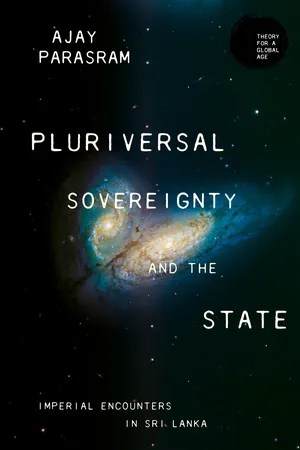
This book documents the political and cosmological processes through which the idea of ‘total territorial rule’ came into being in the context of early- to mid-nineteenth-century Ceylon (Sri Lanka). Analysing ideas at the core of the modern international system, Pluriversal sovereignty and the state develops a decolonial theoretical framework informed by a ‘pluriverse’ of multiple ontologies of sovereignty to argue that the territorial state itself is an outcome of imperial globalisation.
Anti-colonialism up to the middle of the nineteenth century was grounded in genealogies and practices of sovereignty that developed in many localities. By the second half of the century, however, the global state system and the states within it were forming through colonising and anti-colonising vectors. By focusing on the ontological conflicts that shaped the state and empire, we can rethink the birth of the British Raj and locate it in Ceylon some 50 years earlier than in India. In this way, the book makes a theoretical contribution to postcolonial and decolonial studies in globalisation and international relations by considering the ontological significance of ‘total territorial rule’ as it emerged historically in Ceylon.
Through emphasising one important manifestation of modernity and coloniality – the territorial state – the book contributes to studies in the politics of ontological pluralism in sovereignty, postcolonial and decolonial international studies, and globalisation through colonial encounters.
“Parasram lays out a thought-provoking argument – while European colonialism and European ideas fashioned a territorially grounded account of sovereignty, in that very fashioning we encounter an ontological collision between modernist-liberal accounts of sovereignty and the sovereign traditions of the colonised. When sovereignty is revalued, the consequences are devastating.”
– Roshan de Silva-Wijeyeratne, Dundee Law School, University of Dundee
“Parasram’s erudite and compelling re-visioning of the colonial encounter via the notion of ‘galactic collision’ is a joy to read and think with. In reading the ontological foundations of the modern territorial state through what it displaces, the author gives new urgency to the horizons of pluriversal sovereignty for IR. “
– Meera Sabaratnam, University of Oxford
Find at Manchester University Press
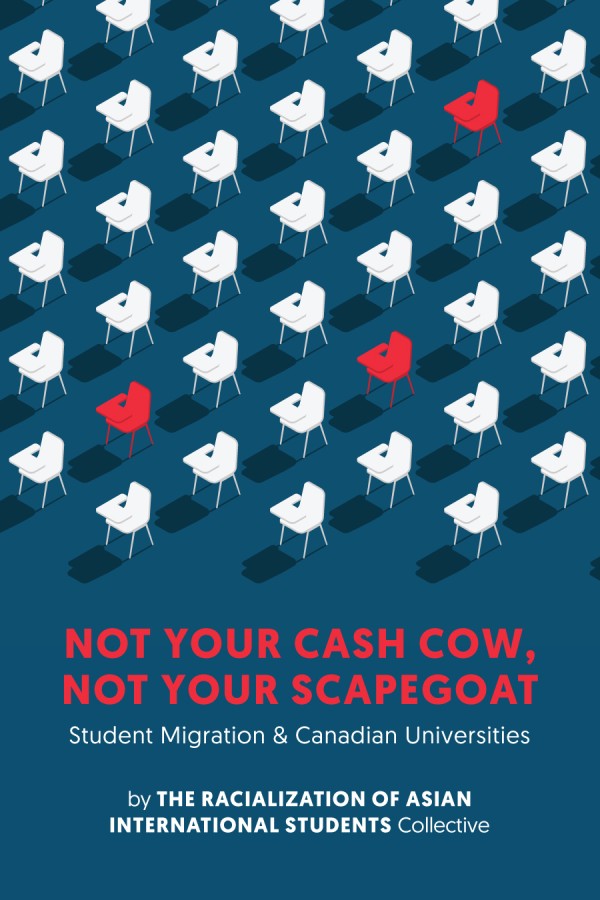
International students have long been seen as cash cows by Canadian universities, a revenue stream of high tuition fees for the same education received by lower-paying domestic students. While in the past their inclusion has been lauded as “recruiting global talent” to Canada, more recently these students have been blamed for social issues from housing shortages to spreading disease — both reductive framings that instrumentalize student migrants for political purposes. Meanwhile, student migrants are often surprised to face isolation, poverty and racism, and disappointed by lacklustre university services meant to help them navigate life in Canada.
This book places the international student within the larger context of edugration, or student migration, to examine the everyday vulnerabilities arising from this immigration status. It gathers insights about racialization from over 120 nationwide interviews with student migrants from Asia, revealing how student migrants cope with prejudice, create networks and manage their own integration. Collectively written by postsecondary educators, researchers and students, including student migrants themselves, this book features evidence-based, critical and antiracist recommendations toward holistically supporting student migrants from Asia to Canada.
“Rigorous and clearly written. A major contribution to empirical and primary research on migrant students’ experiences.” – Jaime Liew, author of Ghost Citizens and Dandelions
The Racialization of Asian International Students (RAIS) Collective is a team of racialized and non-racialized postsecondary educators, researchers and students, including student migrants from Asia, all located in Canada. Our research collaboration stems from the observation that international students, particularly those from Asia, have differing experiences in the Canadian postsecondary education sphere, compared to students from other places. Launched in 2018, our project was initially to document and compare the treatment of international students from Asia at five Canadian universities. Deeply affected by the COVID-19 pandemic, this national team turned to unpacking the vulnerabilities of student migrants and their resiliency amid the simultaneous rise of anti-Asian racism, instrumentalization of international students by Canadian institutions, and growing xenophobia in public discourse regarding international students and their integration into Canadian society. Dedicated to understanding the connections between the experiences of student migrants and other Canadian realities, including settler colonialism, racism, sexism, classism and ableism, the RAIS Collective and its individual members are committed to advocating for better support for student migrants, within universities, in the media and through activism.
The RAIS Collective is composed of Firrisaa Abdulkarim, Elizabeth Buckner, Elic Chan, Soma Chatterjee, Ann H. Kim, Eun Gi Kim, Yifan Liu, Sophie Xiaoyi Liu, Yazhi Luo, Marie-Odile Magnan, Jean Michel Montsion, Ajay Parasram, Shirin Shahrokni, Roberta Soares and Lori Wilkinson.
Find at Fernwood Publishing

Are you a white person with questions about how race affects different situations, but you feel awkward, shy, or afraid to ask the people of colour in your life? Are you a racialized person who is tired of answering the same questions over and over? This book is for you: a basic guide for people learning about racial privilege. In Frequently Asked White Questions, Alex Khasnabish and Ajay Parasram answer ten of the most common questions asked of them by people seeking to understand how race structures our every day. Drawing from their lived experiences as well as live sessions of their monthly YouTube series Safe Space for White Questions, the authors offer concise, accessible answers to questions such as, “Is it possible to be racist against white people?” or “Shouldn’t everyone be treated equally?” With humour and compassion, this book offers relatable advice and a practical entry point into conversations about race.
“Frequently Asked White Questions makes an important contribution to the literature on race. The book is a practical, readable, no-nonsense guide providing answers to questions that white people frequently ask about race. Parasram and Khasnabish take a complex, emotionally charged, serious subject and make it accessible and interesting to readers. Their goal is to invite people, especially white people, into conversations about race and to do so without shaming or dissing them yet holding whites accountable for our role in maintaining white privilege and white supremacy. They do a masterful job of explaining complex terms and ideas (e.g., critical race theory, cultural appropriation, structural racism) in clear, direct language, debunking the mythologies about them created in our everyday discourse, and giving people the tools to respond when the terms are misused. The book is focused on Canadian issues regarding race, primarily around Indigenous Peoples and colonialism, but these issues have broad relevance throughout the world, and are especially salient for US readers. The book provides an excellent way for US readers to understand white supremacy as an issue that is not limited to the US. The authors use numerous examples of real conversations people might have and provide pragmatic suggestions for how to keep those conversations going plus good advice for when people should consider not engaging in further conversation. This book offers an excellent addition to our toolbox for moving the discourse on building an equitable and inclusive society forward.” – Fern L. Johnson & Marlene G. Fine, authors of Let’s Talk Race: A Guide for White People
“A gutsy, clear, compelling pep talk for the white anti-racist. The candour and focus on practice will reach many people.” – Ardath Whynacht, author of Insurgent Love
Find at Fernwood Publishing
 Ajay Parasram